
Why do I keep getting injured after cancer? And here’s how to avoid it.
Life is short, ladies. Life is short. After cancer it’s our time to say YES. Make the plan. Book the trip. Let’s go!
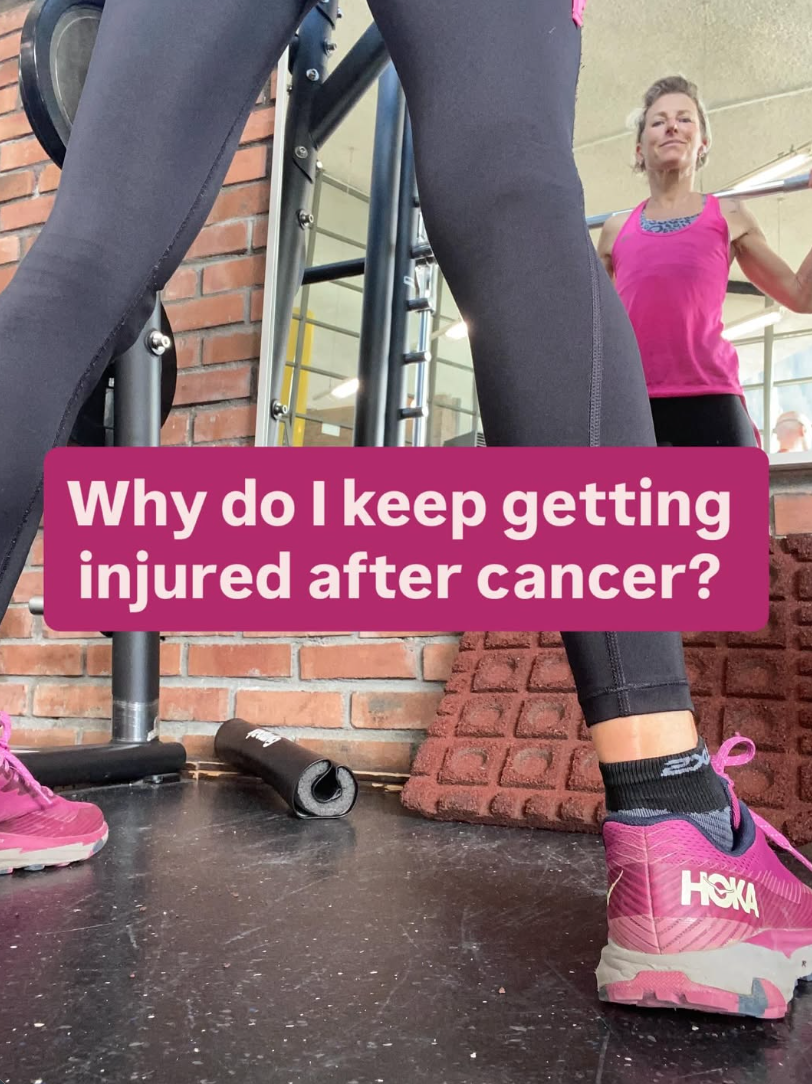
Why do I keep getting injured after cancer?
You’ve finished treatment. You’re ready to get back to running, cycling, the gym or whatever makes you feel like you. So why does it feel as though every time you get going, something hurts? You’re not alone — and there are reasons why your body might be more vulnerable to injury after cancer.
Yes, it happened to me, too.
You get through cancer treatment. You pick yourself up off the ground, dust yourself down and start making an effort to get back into exercise.
You drag yourself to the gym. You start running or cycling again. Maybe you return to tennis, swimming or your favourite fitness class.
You’re SO ready to feel normal again.
You want to do the work. You’re desperate to feel fit and strong. You want your body to feel like your own again.
And then, just as you're getting into your stride…
BAM. 💥 Injury.
A dodgy knee. A painful shoulder. An angry Achilles tendon. A pulled muscle that refuses to settle.
It feels incredibly unfair. You’ve already been through so much. Surely your body could give you a break?
The frustrating truth is that injuries and persistent aches can be common after cancer treatment. But understanding why they happen can help you approach exercise differently, build strength more sustainably and reduce your risk of getting stuck in the injury cycle.
Here’s what I’ve learnt, both from my own experience and from working as a cancer exercise specialist.
1. Your muscles may have lost more strength than you realise 🤕
Cancer treatment places enormous demands on your body. Surgery, chemotherapy, radiotherapy, fatigue, pain and reduced activity can all affect your strength and physical capacity.
Even if you manage to stay active throughout treatment, you may lose muscle mass and strength. You might also lose some of the coordination, stability and movement control that help protect your body during exercise.
The tricky bit? You don't always notice how much you've lost until you start asking your body to do more.
You might remember running 10km before treatment and assume you'll be able to work your way back to that distance fairly quickly. Or you might return to the gym and reach for the weights you used to lift.
But your body has been through a lot, and your previous fitness level isn't necessarily a reliable measure of what your tissues can manage today.
The answer isn't to stop exercising. It's to rebuild your capacity gradually.
Start from where you are now, rather than where you were before cancer. That might mean lighter weights, shorter runs, fewer repetitions or more recovery between sessions. It's not going backwards; it's laying the foundations for moving forwards.
2. Hormone therapy and menopause can change the picture 🧪
For many people, cancer treatment brings an abrupt hormonal shift.
Chemotherapy can trigger early menopause, while treatments such as ovarian suppression and aromatase inhibitors can significantly reduce oestrogen levels. These changes can affect more than hot flushes, sleep and mood.
Oestrogen also plays a role in musculoskeletal health, including the function of tendons and other connective tissues. Hormonal changes may contribute to joint discomfort, changes in tissue function and difficulties recovering from exercise.
Some people experience tendon pain or tendinopathy — a problem involving a tendon that can cause pain, stiffness and reduced tolerance to loading.
If you've developed a new ache or recurring tendon problem since starting hormone therapy, it's worth discussing it with your healthcare team. Not every injury is caused by treatment, but your treatment history is an important part of the picture.
You don't necessarily need to give up the activities you love. You may simply need to adapt the type, intensity and timing of your exercise while you build your tolerance.
3. Your cardio fitness can return faster than your tissues can adapt ❤️
This is one of the biggest traps when returning to exercise after cancer.
Your heart and lungs can respond relatively quickly to regular aerobic training. You might notice that your breathing improves, your energy increases and you can cycle further or run for longer.
Brilliant, right?
But your muscles, tendons, ligaments and bones have their own adaptation timelines. They need appropriate, progressive loading over time to regain strength and tolerate the demands you're placing on them.
This can create a mismatch: you feel fit enough to do more before your body is structurally ready to cope with it.
I think of it as putting a Ferrari engine in a battered old Mini. The engine is ready to go, but the rest of the car needs some attention first!
The solution is to build your aerobic fitness alongside strength, balance and controlled resistance work. Don't let improving stamina be the only measure of your recovery.
So, what can you do to reduce your risk of injury?
The good news is that there are practical ways to help your body adapt and get stronger.
⏰ Take it slowly — slower than you want to
I know. You want to feel normal yesterday. But resist the temptation to make big jumps in distance, speed, weights or training frequency. Give your body time to adapt.
💤 Recover hard
Rest isn't wasted time. It's part of training. Your body needs recovery between sessions to repair and adapt, particularly when you're managing fatigue or treatment side effects. Sleep, nutrition and appropriate rest days all matter.
💪 Progress your training
Going too hard too soon can cause problems, but doing the same easy workout forever won't necessarily rebuild the strength you need either.
Gradually increase the challenge as your body adapts. Change one thing at a time — perhaps the weight, number of repetitions, duration or intensity — rather than increasing everything at once.
🎧 Listen in to your body
Don't ignore a niggle just because you're determined to stick to your plan. Pay attention to pain that persists, worsens or changes the way you move. If symptoms aren't settling, seek advice from a qualified healthcare professional rather than trying to push through.
💃 Mix it up
Variety helps you develop different aspects of fitness without repeatedly placing the same demands on the same tissues. Combine appropriate aerobic exercise with strength, mobility and balance work, adjusting the mix to suit your body and recovery.
💀 Build your core strength
Your core muscles help stabilise your trunk and control movement. Developing core strength can support everyday function and help you perform other exercises with better control. Start with manageable exercises and progress as your strength improves.
🐘 Don't be scared of lifting weights
Resistance training can be an important part of rebuilding muscle and strength after cancer. You don't have to lift heavy straight away, but don't assume that light exercise is all you'll ever be capable of, either.
Start at an appropriate level and increase the load gradually. If you've had surgery, lymph node removal, bone health concerns or other complications, get individual guidance on what is safe and suitable for you.
🆘 Ask for help
You don't have to figure it all out alone.
A physiotherapist or cancer exercise specialist can help you understand what might be contributing to your injury, adapt your training and build a realistic plan for getting stronger. New or severe pain, suspected fractures or symptoms that are rapidly worsening need prompt medical assessment.
You can get stronger again — but you don't have to rush
If you're recovering from cancer and seem to be collecting injuries every time you try to get fit, please don't assume your body is broken or that exercise is no longer for you.
Your body may simply need a different approach, more time and a better balance between training and recovery.
I've had to learn this myself. Being active is a huge part of who I am, and accepting that I can't always do what I want, when I want, hasn't been easy. But adapting isn't giving up. It's how we keep moving forwards.
You deserve to feel strong, capable and confident in your body again. The aim isn't to get back to your old training plan as quickly as possible. It's to build a body that can support the life you want to live now.
If you're struggling with recurring injuries or aren't sure how to return to exercise after cancer, drop me a line. There's no obligation — I'm happy to help you think about your next steps.
Let's find a way to get you moving forwards, one step at a time. ❤️