
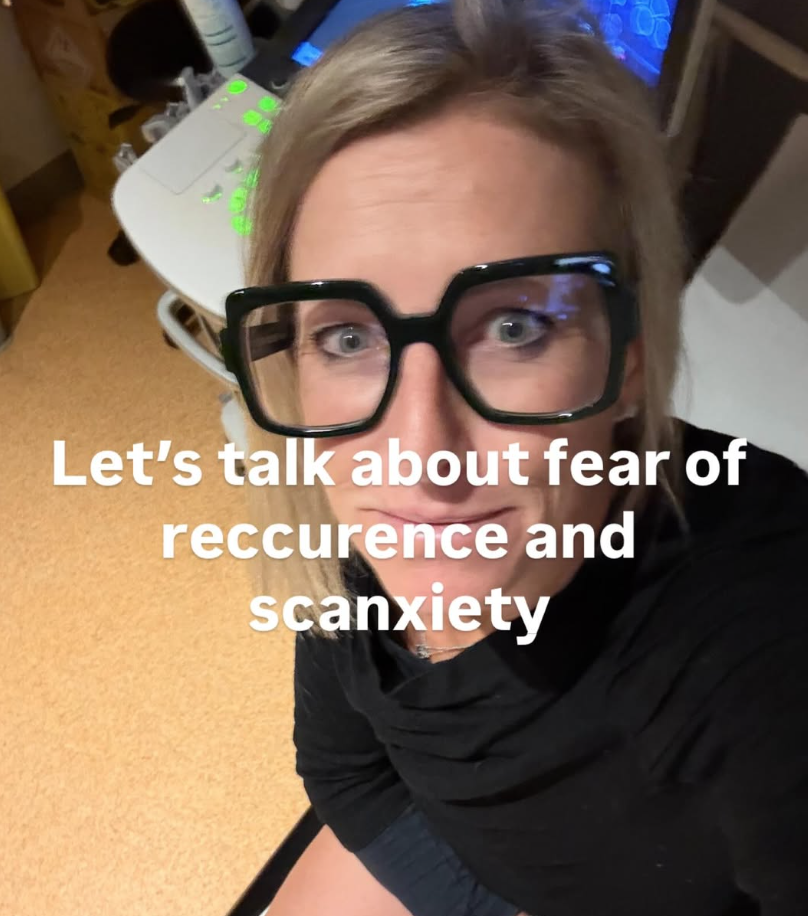
Fear of recurrence doesn’t ever go away. We will never go to a doctor’s appointment or scan and not think ‘what if’ … here’s how to handle it better.
Scanxiety: the part of life after cancer that never really goes away
Another day, another doctor’s appointment. As cancer survivors, we learn to live with uncertainty, but that doesn't mean the fear ever disappears. Sometimes, all it takes is a familiar waiting room to take us straight back to the beginning.
Another day, another doctor’s appointment.
As cancer survivors, we tread a fine line between advocating for ourselves, pushing for tests and scans, and worrying that we’re becoming hypochondriacs.
When do you trust your instincts? When do you push for further investigation? And when do you accept that perhaps it’s just an ache, a pain or one of those annoying things that comes with getting older?
My view has always been that if my cancer is going to come back, I want to know sooner rather than later.
So, yes, I probably push a little harder than some people might.
Maybe my awareness is heightened because of my work as a cancer exercise specialist. I spend so much time thinking about cancer, treatment and recovery, and supporting other people through their own experiences.
Or maybe it’s simply because I have a fierce determination to see my children grow up.
Whatever the reason, I know that the possibility of recurrence is never very far from my mind.
When a niggle becomes something more
For the past few months, I’ve had a niggly pain in my hip.
It comes and goes. Sometimes it’s intense enough to make me catch my breath, but then it disappears. Other times, it throbs and lingers before gradually fading away.
It’s not constant, and it doesn’t immediately scream cancer recurrence.
As a sports therapist, I’ve prodded and poked around, trying to work out what might be causing it. I’ve considered the usual suspects, but it doesn’t feel muscular. The pain seems to come from somewhere deeper.
And so, eventually, I decided to request a scan.
The logical, rational part of my brain knows that there are many possible explanations for hip pain, and that cancer recurrence isn't the most likely explanation for every ache or niggle.
But the emotional, scared part of my brain has other ideas.
It doesn't take much for me to disappear down a rabbit hole of worst-case scenarios. A quick search for possible causes can turn into an unwanted mental tour of everything that could possibly go wrong.
I know how unhelpful that can be. I know that worrying doesn't change the outcome.
But knowing something logically and feeling it emotionally are two very different things.
And when you've had cancer, it's hard not to wonder.
Back to the beginning
So here I am, back in the scan centre where I was first diagnosed with cancer.
Waiting.
Scared.
Trying to read the radiologist’s face for any clues.
It's extraordinary how quickly a place can transport you back to a moment in your life that you would give anything to forget.
The smells. The posters on the wall. The little changing room. The click of the door lock. Even the brand of hand gel.
Every tiny detail feels familiar.
I remember the toilet where you go to take a deep breath and have a word with yourself while you wait for the report. The place where you try to gather yourself together, push the fear aside and prepare for whatever comes next.
It's not just a building. It's a whole collection of memories, emotions and physical sensations that my body seems to remember, even when I'm trying to tell myself that this is just another appointment.
And suddenly, I'm not the person I am today. I'm back there again, feeling vulnerable and frightened, waiting for someone else to tell me what's happening inside my body.
That is the thing about cancer. The experience doesn't necessarily stay in the past just because the treatment has ended.
Sometimes, all it takes is a familiar smell, a waiting room or the sight of a scanner to bring it rushing back.
Scanxiety is real
There's a word for this: scanxiety.
It's the anxiety that can surround medical tests, scans and waiting for results. For many cancer survivors, it can be particularly intense around follow-up appointments or when a new symptom needs investigating.
And it makes sense.
We've experienced what it feels like to have our lives turned upside down by a diagnosis. We've learnt that the things we thought were certain can change in an instant.
So when something unexpected happens in our bodies, it's difficult not to wonder whether it could be happening again.
We might try to rationalise it. We might tell ourselves that we're being ridiculous, that it's probably nothing, that we should stop worrying.
But fear doesn't work like that.
You can understand the statistics. You can know that there are plenty of benign explanations for your symptoms. You can have a wonderfully supportive family and a busy life full of things to look forward to.
And still feel terrified.
Sometimes, I think one of the hardest parts of life after cancer is the expectation that we should somehow be over it. That once treatment finishes, we should be able to move on and get back to normal.
But what is normal when you've experienced something that changes the way you think about your body, your health and your future?
For me, part of living with cancer has been learning to acknowledge the fear without allowing it to take over completely. To recognise when I need reassurance, when I need to ask questions and when I need to give myself a little compassion.
And sometimes, it means accepting that I can't think my way out of being scared.
And then comes the relief
When the radiologist tells me there's nothing she can see, the relief is enormous.
That feeling when the breath you've been holding finally escapes. When your shoulders drop. When the tension starts to leave your body.
For a moment, everything feels lighter.
I'm incredibly grateful for that reassurance. And I'm aware that not everyone gets the news they're hoping for, which makes the relief feel even more precious.
Of course, one reassuring scan doesn't mean I'll never worry again. Nor does it explain every possible cause of pain. I'll follow up with my healthcare team if the symptoms persist or change.
But for now, I can breathe.
And perhaps that's enough.
Being a cancer patient never really ends
I wish I could say that four years after my diagnosis, I no longer think about cancer. That I've learnt all the lessons, made peace with the uncertainty and moved on.
But that wouldn't be honest.
Cancer is part of my life now. It has shaped my work, my relationships, my priorities and the way I think about the future. It has given me some extraordinary opportunities and brought some incredible people into my life.
But it has also left me with a heightened awareness of my own vulnerability.
I don't want to spend my life waiting for cancer to return. I want to live it, enjoy it and make the most of the time I have.
But I also know that living well after cancer doesn't mean pretending the fear isn't there.
Sometimes, it means making the appointment. Asking the question. Requesting the scan. Advocating for yourself when something doesn't feel right.
And sometimes, it means sitting in a familiar waiting room, remembering how far you've come, and finding the courage to face the uncertainty all over again.
If you're experiencing scanxiety, or finding that a new symptom has stirred up old fears, please know that you're not alone. You aren't weak, and you aren't being ridiculous for feeling frightened.
You have been through a lot.
Be kind to yourself. Ask for the support you need. And don't feel you have to navigate the emotional side of life after cancer on your own.
Because even when treatment ends, the experience of cancer can stay with us in ways that other people don't always see.
Being a cancer patient never really ends. But neither does the possibility of building a life full of joy, purpose and adventure alongside it. ❤️